
How to Improve Your EPC Rating from D to C: Birmingham Guide
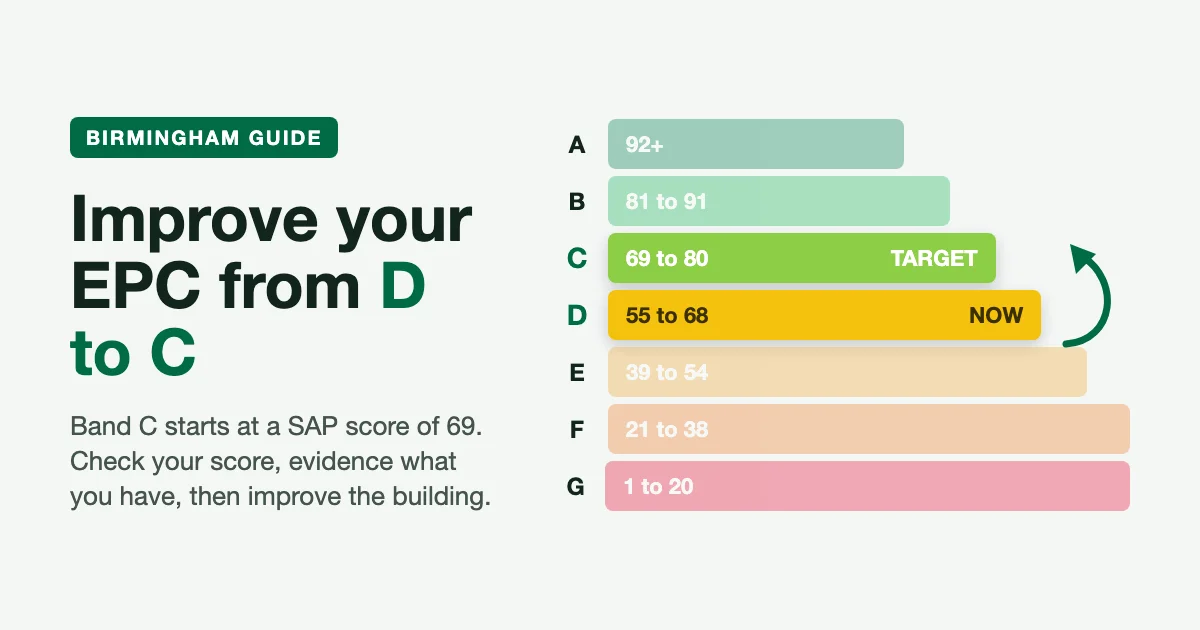
Band C starts at a score of 69. A D rated home scores between 55 and 68, so some homes are only a few points short. Before paying for work, check your exact score, gather proof of improvements you have already made, and then tackle insulation and heating in that order.
This guide is for Birmingham homeowners and landlords with a D rating who want to reach C. It explains how an assessor records your home, which improvements usually matter most for common local house types, and when to book the new assessment. Every home is different, so treat the examples as typical routes rather than a promised result.
Step 1: find out how far you are from C
Search your address on the government EPC register. The certificate shows your current score, a potential score, and a list of recommended improvements with an estimate of how each one could change the rating. Those recommendations are specific to your property, so they are a better starting point than a generic checklist.
Look at the gap. A home scoring 67 needs a different plan from one scoring 56. Also check the date: an older certificate may not reflect work done since, such as a new boiler or insulation.
Step 2: claim the points you may already have
This is the step most guides skip. The assessment is non-invasive: the assessor records what they can see, and uses documents for what they cannot. Elmhurst's assessment guide explains that hidden insulation needs supporting documentation. Without evidence, the assessor must use default assumptions for the age of the building, which can understate a home that has been improved.
Before the visit, gather any of these that relate to the property:
- A cavity wall insulation guarantee or installer's certificate.
- Invoices or photographs for loft insulation, especially if the loft is hard to reach or boarded.
- Paperwork for insulation hidden behind a loft conversion, extension or internal wall lining.
- Boiler make and model, and the heating controls you have: programmer, room thermostat and radiator valves.
- Window and door certificates showing installation dates.
- Certificates for solar panels or other renewable systems.
The assessor decides what evidence is acceptable. A quotation for planned work does not count as proof that it was installed.
Step 3: improve the building before the extras
Work through your certificate's recommendations in roughly this order. It follows the building fabric first, then heating, then smaller items:
- Loft insulation, topped up where it is thin or missing.
- Cavity wall insulation, where the walls have an unfilled cavity.
- Heating controls, such as a programmer, room thermostat and radiator valves.
- An efficient boiler, if the current one is old.
- Hot water: an insulated cylinder, if you have one.
- Low-energy lighting: cheap, but usually worth only a small gain.
Replacement windows and solar panels can help, but they cost more for each point gained in many homes. The government's energy improvement service also suggests measures for your home, with estimated costs, and links to grant schemes that may help pay for them.
Typical routes for Birmingham homes
Pre-1919 terraced houses. Many older terraces in areas such as Small Heath, Sparkhill and Kings Heath have solid brick walls with no cavity to fill. Loft insulation, heating controls, an efficient boiler and hot water improvements are usually the practical first steps. Solid wall insulation can make a large difference but is more disruptive and expensive, so get specialist advice before committing.
1930s semi-detached houses. These usually have cavity walls. If the cavity is unfilled and suitable, cavity wall insulation plus a loft top-up is often the biggest single move. If the cavity was filled years ago, find the guarantee: it may be worth points you are not currently getting.
Flats. You may not control the roof or external walls. Focus on heating, controls and hot water, and ask the freeholder or managing agent for records of any building-wide insulation work.
Landlords: why timing matters before 2030
The current minimum for privately rented homes in England and Wales is E. In its January 2026 response, the government announced that all tenancies must meet a higher standard by 1 October 2030, with legislation planned for 2027 and a £10,000 cost cap per property.
Two details affect your plan. First, the response says a home rated C or higher under the current rating on an EPC issued before 1 October 2029 will count as compliant until that certificate expires. Second, future compliance will be measured first on the new fabric performance metric, which reflects insulation and the building itself. Improving the fabric now helps under both systems. These are announced plans, not law yet, so check the official guidance before making decisions. Our MEES 2030 guide separates today's rules from the planned changes.
When to book your new EPC
Book the new assessment once the work is finished and you have the paperwork in hand, not before. A certificate records the home as it is on the day of the visit. Have the evidence from Step 2 ready and tell us about any recent work when you book.
No one can guarantee a band before the assessment, and a new certificate may occasionally score lower than an old one if the old record was inaccurate. An accurate, evidenced record is the goal.
Ready to check your new rating?
Your Home Specialist provides domestic EPC assessments from £60 across Birmingham and the West Midlands. Read what an assessor checks and our EPC cost guide, then book a time that suits you.
Book an EPC assessment